 Thrive Guitar
How to Set Up a Guitar Practice Space at Home
Learn how to set up a guitar practice space at home, organize your materials, choose essential equipment, and remove barriers to consistent practice.
By Jordan ·

I've been having a hard time establishing any real momentum with my guitar practice lately.
Between work and the usual demands of day-to-day life, finding the time to sit down and play has been challenging enough. But I've also noticed something else.
When I finally do find a few minutes, I'm not always prepared to use them. I go and shoot pool, or I pick up the guitar and aimlessly noodle and accomplish, basically, nothing.
Maybe I need to find a chord sheet. Maybe I can't remember where I left off in a lesson. Maybe I need to print some tablature or figure out where I'm going to sit.
The problem is, I don't sit down with the deliberate intention to practice. I'm just killing time.
By the time I've gathered everything, my available practice time is shrinking rapidly or disappearing entirely.
Sound familiar?
I've recently started doing something about it. I picked up a chair specifically for guitar practice, a guitar footrest, and a music stand. Nothing particularly exciting, but they're things I've needed for a while.
I don't have an iPad or a fancy digital sheet music setup. I've got a printer, and for now, printed music will work just fine.
I'm not building a professional recording studio here. I'm trying to make it easier to sit down and play guitar.
And I suspect that's exactly what a lot of us need. I've learned a few things along the way, and I'd like to pass them along to you.
I work in IT, and when we're troubleshooting a problem, one of the first things we do is eliminate the obvious.
That's what we're doing here. We're identifying and eliminating the obvious bottlenecks and barriers that get in the way of practicing guitar. Sometimes the simplest changes can make the biggest difference.
First, Decide What You're Actually Going to Learn
Before we start rearranging furniture or shopping for accessories, there's something more important to figure out.
What are you planning to practice? Do you have a plan at all?
It might sound obvious, but this is where I'd begin. Speaking from experience here, by the way.
If you're learning a tune, what exactly does that mean? Are you learning the entire thing?
Just the rhythm guitar parts? The melody? A solo? A particular riff?
Are you working through a guitar course? Developing a technique? Building your repertoire?
The answers determine what you need at your practice station. Each of these types of "projects" may require entirely different setups.
Here's a five-step process I'd recommend.
1. Declare What You Want to Learn
Make a decision.
Need to learn an entire tune? Working through a chord-melody course? Maybe you've decided it's finally time to tackle that ridiculous solo you've been avoiding.
Whatever it is, identify it, and mentally declare that you're going to learn whatever it is you're contemplating.
You don't have to commit to learning everything at once. Just decide what deserves your attention. Simple as that.
2. Define Exactly What You're Learning
Now get specific.
If you're learning a tune, determine which parts you're going to work on.
That might include:
- Intro, verse, chorus, or bridge
- Chord progressions and rhythm parts
- Melodies, riffs, or solos
- Lyrics and vocal arrangements
- A complete chord-melody arrangement
You can break these down even further if necessary.
The point is to replace a vague intention like I'm going to work on this tune with something you can actually sit down and do.
3. Document It
Write down what you've decided.
This doesn't need to be complicated. A notebook, a spreadsheet, or an application like Thrive Guitar will work.
Record what you're learning and, if possible, break it into manageable pieces.
Don't hesitate to get specific, either. If it's a complicated piece, make it "measures 1–4". If it's an entire tune, break it down section by section: Intro, Chorus, Bridge, Solo, Outro, etc.
Here's my rough outline of Silent Lucidity after I studied it.
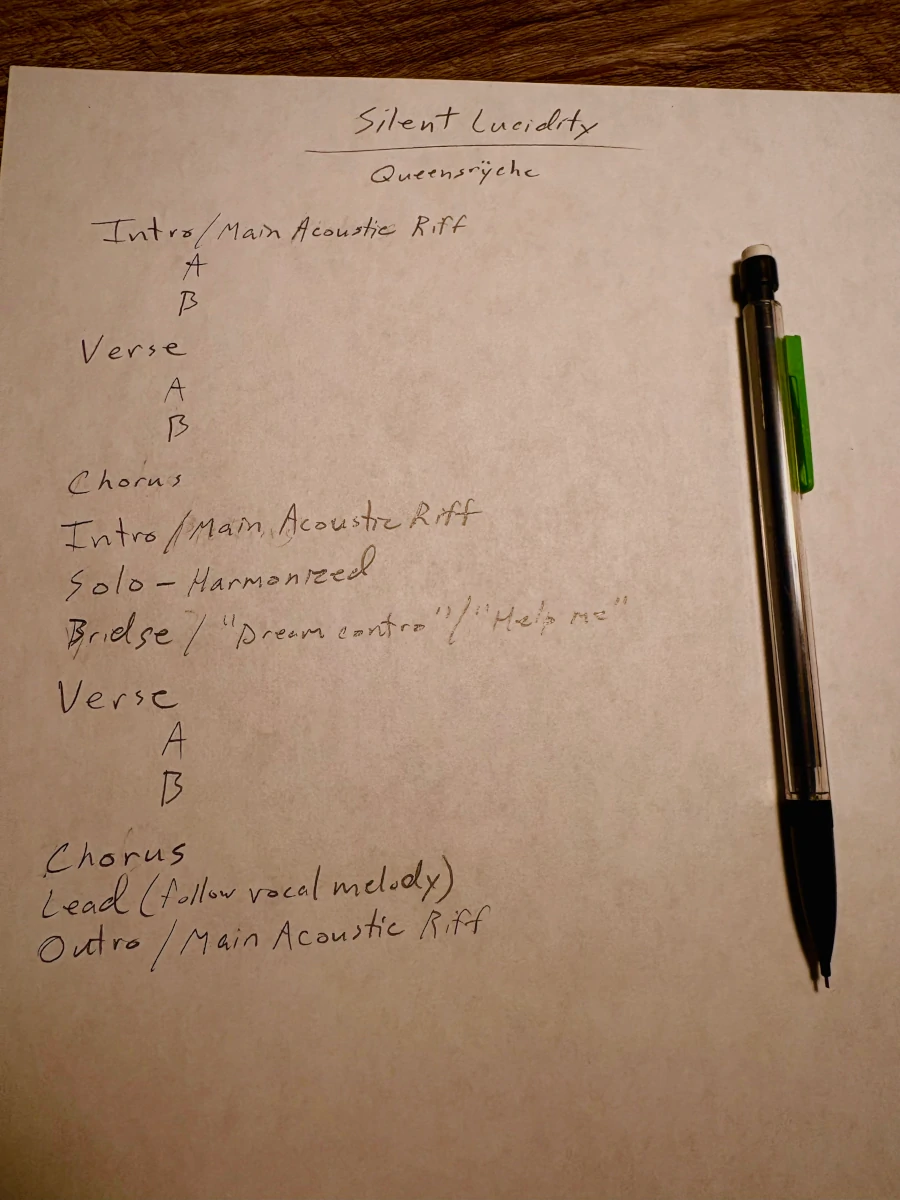
Having a written plan means you don't have to reconstruct your intentions every time you sit down.
4. Figure Out What Materials You'll Need
Now that you know what you're working on, ask yourself what you'll physically need to make progress.
Maybe it's a chord sheet, a printed tab, or a music book. Perhaps you need a metronome, a backing track, or a video lesson.
You might also need blank tablature paper, manuscript paper, a pencil, or somewhere to take notes.
Let the music determine the materials, not the other way around.
5. Gather Everything Before You Practice
This is where the preparation starts paying off.
Print the charts. Bookmark the lessons. Find the backing track. Put the music on your stand.
If you're working on a difficult passage, make sure you know where to find it.
Ideally, the next time you sit down, you should be able to begin practicing almost immediately.
And if you only have twenty minutes available tonight, spending some of that time getting everything ready for tomorrow might be a perfectly worthwhile use of it.
You're removing obstacles before they have a chance to interrupt you.
Build a Practice Station, Not a Home Studio
Here's something I have to remind myself of.
A guitar practice station and a home recording studio are not necessarily the same thing.
I enjoy recording and would love to have everything in one convenient location. But that's not really how my current setup works.
And that's okay.
It's easy to get carried away imagining the perfect guitar room. Multiple guitars hanging on the wall, a nice desk, studio monitors, recording equipment, acoustic treatment, and enough cables to wire a small television station.
But do you need all that to practice a chord progression? Probably not.
A practice station should make it convenient to learn, review, and play music. A recording studio serves a different purpose.
There's certainly some overlap, but don't convince yourself that you need a fully equipped studio before you can establish a productive practice routine.
Your practice station might be nothing more than a chair, a guitar, a music stand, and a few well-organized materials.
That's enough to get started.
Three Levels of Guitar Practice Setup
Not everyone has a spare bedroom to dedicate to music. Some of us are working with a corner of the living room, a home office, or whatever space the rest of the household hasn't claimed yet.
Fortunately, you can build a useful practice area without spending a fortune.
Here are three ways to approach it.
| Setup | What You'll Need | Best For |
|---|---|---|
| Minimum | Guitar, suitable chair, tuner, and somewhere to view music | Getting started with very little space or expense |
| Comfortable | Add a music stand, small shelf, good lighting, and a headphone solution if needed | Regular practice with fewer interruptions |
| Dedicated | Add a permanent display, organized music library, playback equipment, and optional recording capability | A more permanent practice area with additional flexibility |
There's no requirement to work your way through all three levels. If the minimum setup meets your needs, that's perfectly fine.
In my case, the new chair, footrest, and music stand are helping me put together something closer to the comfortable setup. I'm currently somewhere between the minimum and comfortable levels.
I still have improvements I'd like to make, but I don't need to wait for everything to be perfect.
Match Your Practice Space to the Music You're Learning
Here's another reason I don't believe in a one-size-fits-all practice station.
Different musical goals create different needs.
A guitarist studying jazz chord melody might need good lighting and a convenient place to display notation.
Someone practicing metal riffs might benefit more from a headphone-capable amplifier, metronome, and an easy way to slow down recordings.
And someone working on building a repertoire needs a reliable way to organize and revisit their material.
Those are all very different musical goals.
| Guitarist | Particularly Useful Setup |
|---|---|
| Chord-melody player | Comfortable chair, chart display, good lighting |
| Metal guitarist | Headphone-capable amp, metronome, convenient playback controls |
| Repertoire-focused player | Organized tune sheets, notes, and current study list |
| Acoustic player | Guitar stand, music stand, tuner, recording device |
Of course, you might fit into several of these categories. I certainly do.
One day you might be studying jazz harmony. The next day you're trying to get a complicated metal riff up to speed. We're musicians, and we don't all fit into one box!
You don't need to rebuild your practice space every time your musical interests change.
But you should make sure the essentials for your current projects are available.
Small Details That Make a Big Difference
Once you've got the basics covered, a few practical considerations can make your practice space considerably more comfortable.
-
Choose a chair that works with your guitar. Some office chairs have armrests
that interfere with your playing position. An armless chair, or one with removable arms, may be
a better choice.
I recently purchased a $60 office chair on Amazon that has flip-up arms, and it's working great. Nothing fancy; it just gets the job done.
-
Pay attention to your music display. Whether you're using printed sheets, a
tablet, or a computer monitor, position your music so you're not constantly bending your neck to
read it.
Being physically comfortable is critical. You don't want nagging distractions that can easily be prevented.
- Get the lighting right. You shouldn't have to strain to read tablature or notation, especially during longer sessions.
- Consider your volume. If you play electric guitar, a headphone-capable amp or modeling setup can make it easier to practice without disturbing everyone in the house. If you have to squeeze in some late-night practice, like I do, you don't want to wake up your spouse or the kids!
- Keep cables under control. You shouldn't have to untangle a pile of cables every time you want to plug in. A booby trap of cables in your practice area is not ideal.
- Protect your instruments. Keep guitars away from direct sunlight, heating vents, and places where they're likely to get knocked over.
- Keep frequently used accessories nearby. Picks, tuners, capos, pencils, and other small items have an amazing ability to disappear exactly when you need them.
None of this is particularly exciting, but it makes all the difference in the world. Sometimes you don't appreciate the mundane work you're doing until you can sit down and enjoy a frictionless session the next time around.
The less time you spend dealing with your environment, the more time you have for the music.
Keep Your Practice Materials Organized
You can have the most comfortable chair in the world, but it won't do you much good if you can't find the music you're supposed to be practicing.
This is another area where I'm trying to improve my own setup.
I've got instructional materials, lessons, chord sheets, and music scattered across different places. Some are digital, some are printed, and some probably exist in a browser tab I haven't seen in three weeks.
Sound familiar?
You don't need an elaborate filing system, but you do need a way to find your current materials quickly.
For printed music, a binder with dividers or a simple folder system might be enough.
For digital material, consider keeping your current lessons, tabs, and reference links organized by tune or project.
I'd also recommend separating the material you're actively working on from everything else you've collected over the years.
You don't need every piece of music you've ever downloaded sitting on your music stand. Sometimes the three to five tunes you're actively working on are all you need.
Just keep your current priorities accessible.
If you're not sure what those priorities should be, I've written more about that in How to Build a Guitar Practice Plan You'll Actually Use.
Leave Everything Ready for Next Time
Here's one final habit I'd encourage you to develop.
When you finish practicing, take a minute to prepare for the next session. I've applied this not only to my guitar playing, but to many areas of life, and it has helped so much.
Put your materials back where they belong. Leave your current music somewhere accessible. Make a quick note about what you accomplished and what needs attention next time.
If you were working on a difficult passage, write down exactly where you stopped.
You might even leave the appropriate chart open on your music stand.
The goal is to make tomorrow's practice session easier than today's.
This connects directly to something I discussed in How to Practice Guitar When You Don't Have Much Time.
When you're dealing with short practice sessions, the time you save by being prepared can make a substantial difference.
A few seconds of preparation today might save several minutes of frustration tomorrow.
Don't Turn Preparation Into Another Excuse
There's one trap worth mentioning before we wrap this up.
It's entirely possible to spend weeks researching equipment, shopping for accessories, rearranging furniture, and designing the perfect guitar room without actually playing much guitar.
Ask me how I know.
At some point, preparing to practice can become another way of avoiding practice.
You don't need to spend three weeks building the perfect practice space only to discover you've become an expert at buying guitar accessories instead of playing guitar.
Start with what you have.
Fix the things that are genuinely getting in your way. Add equipment when there's a clear reason for it.
And remember:
Your practice station is ready when it helps you practice, not when it's finished.
Make It Easy to Pick Up Your Guitar
A good practice space doesn't need to be expensive, impressive, or particularly elaborate.
It needs to work for you.
Know what you're learning. Gather the materials you'll need. Find a comfortable place to sit. Keep your guitar and accessories accessible.
And when you're finished, leave things ready for the next session.
That's really what this is all about.
We're not trying to build the world's greatest guitar room. We're trying to remove the little obstacles that keep us from doing something we enjoy.
If you've been struggling to establish a consistent practice routine, take a look at your environment.
Maybe your practice schedule isn't the problem. Maybe you just need a dedicated area to sit, grab your guitar, and practice the music you're learning.